
https://www.nkcareercenter.org/events-list/kcc-career-fair-pendelton-county-library
Upcoming events.
It all begins with an idea. Maybe you want to launch a business. Maybe you want to turn a hobby into something more. Or maybe you have a creative project to share with the world. Whatever it is, the way you tell your story online can make all the difference.

Building essential skills in your workforce, round 2
In this blog, you’ll learn more about developing adaptability, problem solving, and emotional intelligence in your workforce.
In last week’s blog, Centennial Talent Strategy and Executive Search Executive Vice President Becky Scheeler shared three in-demand essential skills that are easier to teach - communication skills, office etiquette, and collaboration and teamwork. Read the full blog here. Today, Scheeler will share her thoughts about three harder skills to teach: adaptability, problem-solving, and emotional intelligence.
Adaptability refers to the ability to respond quickly to change. It includes adjusting to changing circumstances, priorities, projects, clients, and technology. To master adaptability, employees must learn new skills and behaviors due to changes in the environment and be flexible when new and challenging situations arise.
“Change is a given in today’s workplace,” Scheeler said. “But smart managers recognize how difficult change can be. Explain why the change is happening and allow your employees to mourn briefly. Then move on.”
Managers should model the new behavior they expect in their team. Be prepared to provide examples of when the company or team has had to pivot in the past and how it paid off.
“But remember, it takes time to adapt. It may take several months for employees to adapt fully depending on the significance of organizational changes,” Scheeler said.
Problem-solving skills come into play daily for both small and large decisions. “Make sure your employees feel empowered to solve their problems,” Scheeler said. “Don’t answer all the questions that come to you as a manager. Ask the employee what they think.”
But make sure they know their boundaries. Where is the line at which the employee should involve a manager? Clearly written standard operating procedures are important but must be frequently reviewed and communicated to impact organizational behavior.
“Sometimes I hear managers say they value problem-solving skills, but then they chastise their employees if they make a mistake. It would be better to praise the employee for taking the initiative to solve the problem and then walk through how their solution could have been improved,” Scheeler advised.
Emotional intelligence is more nebulous to define than other essential skills. It involves being aware of emotions in oneself and others and using this awareness to guide thinking and behavior. Emotionally intelligent workers understand and can manage their own feelings first, enabling them to empathize with others and build relationships through effective communication.

Chart of four pillars of emotional intelligence
Managers can help build emotional intelligence in their workers. “After a meeting, ask people how they thought a meeting went and why. Determine if they read the room appropriately. Did they know the audience? Be prepared to discuss your observations,” she suggested.
She also suggested that managers talk to direct reports about how they could have handled a situation better. “Role-playing may seem ‘cheesy,’ but it helps build skills.” Talk about how the employee’s behavior affected the other team members or participants in a group.
Every minute a manager spends developing these essential skills in their direct reports pays off. “The good news is that you can teach your team adaptability, problem-solving, and emotional intelligence. The more intentional a manager is in building these skills, the more effective and productive the team will become,” Scheeler concluded.
If your company needs help building essential skills in your workplace – or finding talent with essential skills – NKY Works can help. We can connect you to resources to address your specific workforce challenges. Contact NKY Works at 859.657.WRKS (9757) or NKYWorks@NKADD.org.

How to build essential skills in your workforce
Essential skills can be build - here are some tips for building the most basic ones in your workplace.
Soft skills. Job skills. Employability skills. Essential skills. Regardless of the term you choose, employers unanimously agree that they are lacking in our workforce. In this blog, we will refer to them as essential skills.
Essential skills are highly transferrable basic abilities needed in virtually every job. They complement “hard skills,” which refer to a worker’s technical capabilities and occupational knowledge. Many essential skills relate to how workers interact with one another. Employers consistently say they can train a worker the hard skills if the essential skills are present.

Centennial Talent Strategy and Executive Search Executive Vice President Becky Scheeler (left) shared three in-demand essential skills that are easy to teach - communication skills, office etiquette, and collaboration and teamwork. She provided the following tips about developing each into the workplace culture:
Communication skills must include spoken, written, and email formats. The company must develop guidelines for internal and external communication standards. Publishing the guidelines once and then never revisiting them is not enough. Employees need to see examples of effective internal and external communication. Scheeler said it is also important to have stated company norms for the time it takes to respond to emails and phone calls.
Office etiquette is often overlooked and includes simple courtesies such as saying “please” and “thank you.” Rather than barging into a colleague’s office or cubical, ask if they have time to talk first. If they do not, ask when they are available. On the other hand, if you tell someone you are available, stop working and make eye contact during the conversation.
Building collaboration and teamwork within your organization starts with some basic courtesies:
Always praise the team for accomplishments - even small ones.
Never take credit for something someone else did.
Do not talk about other people in the organization.
When something goes wrong, talk to the person(s) involved first before making judgments or talking badly about those involved. “Tattling” is never appropriate in the workplace.
“The manager must be willing to lead by example at all times,” Scheeler said, “and when he or she makes a mistake, they must call it out and state how he or she should have done it.”
She said it is critical to give feedback when someone exhibits excellent behavior and also when someone doesn’t behave in a manner consistent with company expectations. “Silence means acceptance to many people,” Scheeler warned.
Most importantly, managers must discuss company and team values every time they meet. As with communication skills, it is important to give examples of what the value looks like in practice. “Talk about what good looks like and what bad looks like and how it makes you feel when values are and aren’t followed.”
Honing one’s skills is essential for every manager. “One of my all-time favorite books is How to Win Friends and Influence People by Dale Carnegie. I had my son read it when he was entering the business world. Many life-long lessons are taught there.”
Next week, we will examine some essential skills that are harder to build in the workplace, specifically adaptability, problem-solving, emotional intelligence, growth mindset, and cultural competency. In the meantime, you can hear more about leadership development from Scheeler and Centennial CEO Mike Sipple, Jr. in their recent podcast.
If your company needs help building essential skills in your workplace – or finding talent with essential skills – NKY Works can help. We can connect you to resources to address your specific workforce challenges. Contact NKY Works at 859.657.WRKS (9757) or NKYWorks@NKADD.org.

New website supports career development in Kentucky
The state of Kentucky has unveiled a powerful new website for career exploration. Learn more in this blog.
Kentucky has a new tool for career exploration called Futuriti. Futuriti helps you explore Kentucky’s career pathways, education and training options, funding sources, and job opportunities. Its Future Finder tool provides state-specific insights on wages, college costs, etc. It’s a project of the Commonwealth Education Continuum (CEC).
The Commonwealth Education Continuum (CEC) is a team of 28 individuals whose expertise ranges from early childhood to the workforce. In addition, CEC workgroups focus on three priority areas identified by the CEC: 9th grade on track, early postsecondary opportunities, and first-year success.

Logo for Futuriti
Here’s the link. Heads up: it’s a robust site. When you explore it, grab a coffee and block out some time. Or, add it to your “Favorites” tab and refer to it frequently, preferably with someone actively exploring careers.
Some insights it offers about career exploration include:
Kentucky has identified five high-demand industry sectors: 1. Healthcare 2. Manufacturing and Logistics 3. Construction 4. Education 5. Professional, Scientific, and Technical Services. The Kentucky Workforce Innovation Board recently updated this list, continuing its emphasis on careers in healthcare, manufacturing, and construction and adding education as a high-demand sector.
Manufacturing jobs are now directly linked with jobs in logistics as the two sectors work hand-in-hand.
The professional, scientific, and technical services category is newly defined as follows: “Professionals in these fields of work may specialize in designing cutting-edge technology, conducting scientific research, managing financial strategies, or offering legal and business advice. These roles require advanced knowledge, analytical thinking, and a commitment to staying ahead of industry trends.”
The education sector encompasses classroom teachers, curriculum specialists, early childhood educators, educational administrators, and educational technology specialists.
The site enables individuals to explore jobs by geographic region and educational level. In the eight-county Northern Kentucky Area Development District, you can find high-demand careers requiring only a high school diploma through careers requiring advanced degrees.
You can quiz yourself in various ways. Discover your strengths, values, and aptitudes. Watch career videos and match them to your interests. These resources can complement the interest and aptitude awareness many local students have gained about themselves through the YouScience assessment in use by many local schools.
The site contains specific tips and resources to address unique needs. In short, it’s an excellent tool for career exploration, especially when combined with the network of services and resources available through NKY Works.
For more information about career exploration, contact NKY Works at NKYWorks@NKADD.org or 859.657.WRKS (9757).

Reinventing your talent pipeline
Companies are working with college students earlier to aid recruitment efforts.
123,000 students attend our region's colleges and universities, and they are our most immediate source of workforce talent. Keeping them in Greater Cincinnati is a high priority for NKY Works. Connecting them to jobs well before graduation is a key strategy for achieving this goal. Companies have found that waiting until students are ready to graduate is not the best recruitment strategy. Instead, they are finding ways to work with students earlier, sometimes years before graduation.
Four companies shared their experiences working with students at the University of Cincinnati and Northern Kentucky University during “Reinventing Your Talent Pipeline” on January 23. These companies are Safran Landing Systems, Western and Southern Financial Services, Global Business Solutions, and Bosch.

NKY Works Director Correy Eimer (left) led a panel of business professionals including (left to right) Bonnie Wathen (Western and Southern), Jim Vatali (Western and Southern), Maria Perez (Bosch), and Kevin Brummer (Global Business Solutions).
The insights they shared included:
Internships are a win/win. Safran’s CEO and General Manager Philippe Garnier said Safran hires 15-30 student interns annually. Students provide much-needed support for Safran’s workload, especially for short-term projects. Students’ reliance on technology to complete their work often results in faster, more efficient methods to move projects forward.
By working with students for two to four months, Safran can identify the “superstars” they want to hire full-time.
Because Safran is a French company, they also hire French interns for their USA operations. “The interaction between our American and French interns is an excellent experience for these students,” Garnier said. “They are learning valuable skills about communicating across cultures.”
Having a campus presence helps. Per Associate Vice President of Remote Sites Jim Vatali, Western and Southern Financial Services opened a contact center at NKU in 2022 and now hires 40 part-time students per year. The students fill a variety of customer service and sales support roles. Last year, Vatali said these students completed an amazing 173,000 client interactions.
Western and Southern added a similar center at UC last year after acquiring Gerber Life Insurance Company, initially hiring 17 students to support insurance sales. These students completed life and health insurance licenses as part of their onboarding process and played a role in the sale of 1,600 new life insurance policies in the first year of operations. Western and Southern intends to hire up to 35 students at its UC Center next year.
After working part-time, several students per year move into internships, and several graduates now annually accept full-time jobs with Western and Southern.
Building relationships within the university pays off. Like Western and Southern, Global Business Solutions (GBS) has an on-campus center at NKU where they hire IT interns. In addition, GBS Director of Strategy & Operations Kevin Brummer participates in the Advisory Committee for NKU’s College of Informatics.
“Building relationships with the people who teach our workforce is very valuable,” Brummer said. “We get to influence what is being taught. In our work at GBS, we deal with many specialized technology needs. It is unrealistic to expect students to learn about all of them. But it is helpful for us to talk with faculty about the changing technology needs of our clients so they can better prepare their students.”
Rotating interns and co-op students within the business helps them find their best pathway. Bosch, a worldwide manufacturing company with a plant in Florence, rotates their co-ops through multiple positions during their employment. “This enables the student to experience several different career pathways to see which one is the best fit for them,” said Bosch’s Maria Perez, who manages their co-op program. Perez also manages the FAME program, an apprenticeship through which students are enrolled at Gateway Community and Technical College while working at Bosch.
“We also talk to our students about continuing their education by enrolling in the ‘2+2’ degree programs at NKU,” she added. The 2+2 programs provide a seamless pathway for associate-degree graduates to pursue their bachelor's degree.
At the event, sponsored by the NKY Chamber of Commerce, the presenters also shared the following tips for establishing successful work-based learning opportunities for college students:
Create a “playbook” for managers who will be working with young people to highlight how to communicate effectively with college students.
Use Handshake to post co-op, internship, apprenticeship, and job opportunities. Handshake is a proprietary career platform used by most colleges and universities in our region. Once a company has posted its opportunities in Handshake, students nationwide can view them.
Mimic your expectations for full-time employment during your internships. If students are expected to dress professionally upon full employment, require it during their internship, too. Students should learn about the company culture through their college-level employment experiences.
Remember that working with students is, as Kevin Brummer said, “a long game.” Students will have a learning curve when they enter full-time employment, even if they worked for your company during college. However, work-based learning experiences can greatly pave the way for successful onboarding into full-time positions.
NKY Works encourages companies to explore work-based learning (WBL) opportunities such as internships and co-ops with both high school and post-secondary students. To talk more about WBL options and your company’s specific workforce needs, contact NKY Works at 859.657.WRKS (9757) or NKYWorks@NKADD.org.

Apprenticeships are increasing, but…
Learn more about the benefits of apprenticeships for your company in this report.
Last week, we shared information about how apprenticeships are increasing in Kentucky and highlighted a new program at Bray Construction Services. (Read it here.) This week, we continue our deep-dive into the benefits of apprenticeships by sharing a recent report from the Hechinger Report. The report highlights several positives and some sticking points for companies considering apprenticeships.
Key points include:
More people want apprenticeships than are available. The demand for apprenticeships is expected to continue to increase under the Trump Administration as President Trump championed apprenticeships in his first administration.
94% of apprentices remain with their employer after their apprenticeship ends. This is an unheard-of retention rate for entry-level workers.
Experts calculate the return on investment for apprenticeships as $1.44 for every $1.00 invested by the employer.
Many states, including Kentucky, provide incentives to businesses for starting apprenticeship programs.
Employers are put off by the amount of red tape involved in setting up and maintaining apprenticeship programs. However, companies can partner with intermediaries to administer their programs.If you want to learn more about intermediaries and other alternatives for managing an apprenticeship program, contact NKY Works at 859.657.WRKS (9757) or NKYWorks@NKADD.org. We can help you explore options to make apprenticeships successful for your business.
Is your interest piqued? Read the full report here.

January Newsletter is now available
Click here to read about the initiatives and upcoming events for NKY Works and its partners.
apprenticeships are increasing in kentucky
(The following is continued from the January 2025 NKY Works Newsletter. To read the full newsletter, click here.)
The popularity and acceptance of apprenticeships as a career pathway for our young people began to wane at the end of the 20th Century as increasing numbers of high school students chose college degrees over apprenticeships. The tide is reversing, however, and apprenticeships are rising nationally, especially in Kentucky, which saw a record number of registered apprentices in 2023, as seen in the chart below.

Over 1,500 occupations are recognized for apprenticeship programs in Kentucky. These programs go beyond traditional construction and skilled trade positions to encompass the jobs of tomorrow, such as aerospace engineer, physical therapy aide, office manager, and even whiskey specialist.
Despite the surge in popularity, companies often express reservations about implementing apprenticeships. Their concerns tend to reflect a lack of information about how apprenticeships work.
“Employers are concerned about the amount of paperwork required,” said NKY Works Director Correy Eimer. Eimer is also the Associate Director of Workforce Development at the Northern KY Area Development District and Director of the NKY Workforce Investment Board. “Recordkeeping is important, but there are many options for streamlining the process,” he said, including using an intermediary. An intermediary is an approved organization that helps businesses set up and administer their apprenticeship programs.
Another misconception is about the benefits to the employer. “Sometimes employers tell us they see how an apprenticeship helps the worker, but they don’t see the benefit to the company,” Eimer said.
There are many potential benefits for employers, starting with continuity and consistency in training new employees. “Well-trained employees result in improved productivity and profitability and a reduction in work-related injuries,” Eimer added.
One local employer, Bray Construction Services, implemented an apprenticeship program this fall to help recruit and retain skilled talent. They now offer apprenticeships for construction laborers and commercial drivers.
“We were having a hard time finding workers with the skills we need,” said Dave Trimble, who administers Bray’s programs. “We decided to grow our own by offering apprenticeships. We have 10 new employees who will be registered in January.”
Trimble believes the structure, training curriculum, and increased attention from job supervisors will help their apprentices master skills faster and increase their retention with the company.
“The program proves how invested Bray is in their success. We pay our apprentices while they are in the related trades training portion of the program.” He said this also prevents seasonal layoffs that Bray’s workers formerly experienced in the winter months.
One of Bray’s 10 apprentices shows how work-based learning opportunities can work together to put a student on a successful career path.
“This young man was a carpentry student at the Campbell County Area Technology Center. He did a co-op with us in his senior year, working in our shop,” Trimble said. “Once he graduated from Dayton High School, he accepted a full-time job as a general laborer. This year, he completed his CDL (commercial driver’s license) through our in-house training program. Now he will complete our two-year construction laborer apprenticeship. After that, he will be in a great position to assume more responsibility as he continues to grow with our company. He could become a foreman within a few years and then a supervisor. The future is bright for this young man.”
NKY Works encourages companies to explore apprenticeships as part of their talent attraction and retention efforts. We are available to talk about your specific workforce needs and options for an apprenticeship program. To schedule a meeting, contact NKY Works at 859.657.WRKS (9757) or NKYWorks@NKADD.org.

Happy boxing day
If you are reading this blog on the day it was posted – December 26 – it is “Boxing Day.” Boxing Day, a public holiday in Great Britain and some other predominately English-speaking countries, has been celebrated for centuries. Its origin is not fully clear, but the two theories are:
Servants and tradespeople required to work on Christmas Day were given December 26 off. They were given gifts – AKA, boxes – from their employers on that day.
Donations given to the poor in alms boxes were distributed on this day. This theory links Boxing Day to the Feast of St. Stephen, which is also December 26. St. Stephen was the first Christian martyr. (Look up the words to the Christmas song, “Good King Wenceslas.” It takes place on the Feast of Stephen.)
Either way, Boxing Day has become best known as a shopping day, akin to our Black Friday. An estimated £3.73 billion (British pounds) will be spent in Great Britain today, up 1.3% over the prior year. Their shopping frenzy will continue throughout the weekend, with a total of £13.7 billion spent between December 25 and 31.
That’s a lot of boxes.

SHINING A LIGHT ON GEN X
The '“latch-key kids” are all grown up and leading our workforce,
We’ve talked about “Gen Z” workers several times this fall. They are the generation of workers who are now entering the workplace or are still in school, preparing for their futures. They are America’s most diverse generation and have already proven that they think and act differently than their older peers. In January, we’ll explore Gen Zs who decided to forego college and enter directly into the workforce when the Cincinnati Workforce Innovation Center publishes its second of two reports based on their research about Gen Z. For now, let’s talk about another generation in our workforce: Gen X.
“Who?” you might ask because they are the generational “middle children.” Sandwiched between the behemoth Baby Boomers and the trend-setting Millennials, Gen Xers were born between 1965 and 1980 and are the smallest generation in the workforce. They may often be overlooked, but they bring a unique set of characteristics important to note.
Gen X may be best known as the first latch-key kids, meaning both of their parents worked outside of the home and they fended for themselves after school. As a result, they are considered fiercely independent and sometimes skeptical of authority figures. They are flexible, which is great for employers but may not be as loyal to their employer as their older Boomer colleagues. They were the first generation to talk about work/life balance.
Although they are not “digital natives” like Millennials, they were exposed to technology as they transitioned to adulthood. They experienced the change from analog to digital technologies and can embrace both. Technology went from being a luxury to being a daily necessity as their careers took off. “Digitally savvy” is a phrase often used to describe Gen X.
They are a retailer’s dream. They grew up in malls and largely had access to disposable income through their increasingly affluent, two-income parents. Their penchant for spending has had consequences. As a group, they reportedly still live paycheck to paycheck and have little to no retirement savings. This is partly because they entered the workforce as companies moved away from pension plans in favor of defined contribution plans (e.g., 401K plans), which required them to invest to reap the maximum benefit toward retirement. They also experienced several economic downturns over their careers, including the bust of the “Dot-Com” industry and more impactful, the Great Recession of 2008.
The Great Recession had an enormous impact on them. Their net worth tumbled to almost half of its earlier value. They had more debt than the older generations and fewer assets, most notably less equity in their homes. Per the Pew Research Center, the median net worth of Gen X households declined 38% from 2007 ($63,400) to 2010 ($39,200), while the typical wealth loss for the older Boomer and Silent Generation households was 16% and 14%, respectively (Gen X the only generation to rebound from Great Recession in wealth).
But Gen X’s most defining characteristic –resilience – has served them well since the recession. They keep pushing forward. They reinvent themselves. They have shed their reputation as workplace “slackers” and have become known as hard workers. They regained the wealth they lost in the Great Recession and more. Most of them are now at their peak earning age of 45 to 54. Significantly, they tend to be entrepreneurs. 46% of small business owners in the US belong to Gen X while only 41% are Boomers, 13% are Millennials, and 1% belong to Gen Z (Guidant Financial, 2021). Though small, Gen Xers are vitally important to our continued economic growth.
Their flexibility has also served them well in the workplace. Gen Xers are valuable employees because they are equally comfortable working in teams or alone. As Millennials and Gen Z have entered the workplace, they have become the bridge between older and younger workers. They have slowly and quietly risen to leadership positions in their companies and now fill the greatest percentage of leadership roles globally (Meet Your New Boss: Gen X | Psychology Today). As the Boomers fully exit the workplace over the next decade, the impact of Gen X will continue to increase.
So, let’s turn the spotlight on Gen X. You may be small, but you are mighty. Gen Xers, we applaud your contributions and look forward to seeing what trails you will blaze in the coming years. As business leaders and owners, you may be facing workforce challenges. Let NKY Works help. NKY Works is a collective impact workforce development initiative dedicated to helping employers address their workforce talent challenges. If you need assistance, NKY Works can connect you to a broad array of resources to meet your comprehensive workforce needs. Call 859.657.9757 or email NKYWorks@nkadd.org for more information.

We have work to do in preparing our workforce for continued economic growth
Recent economic forecasts point to the need for continued workforce priorities.
If you were among the nearly 200 community leaders who attended November’s Eggs and Issues meeting, sponsored by the NKY Chamber of Commerce, you heard predictions about our 2025 economy from NKU Senior Director of the Center for Economic Analysis and Development Janet Harrah. Harrah was joined by Huntington Bank’s John Augustine for the presentation. Augustine provided an overview of the national economy, and Harrah took a deeper dive into our local economic outlook. This blog will highlight her insights as they relate to the Greater Cincinnati workforce. Specifically, we will explore four topics: the civilian labor force, job growth, unemployment rates, and the skills gap.
1. Our civilian labor force (CLF) is not growing as quickly as that of the United States. As the first chart below shows, the US labor force has grown by 7.2% over the past decade while it has only grown by 6% here. While 1.2% may not seem significant, it translates to 10,300 additional workers who would have been available to fill our jobs. Perhaps more alarming, Harrah forecasts that our CLF will decline over the next 25 years (as seen in the second chart below) as the Baby-Boomer generation fully retires, leaving the smaller generations behind them to fill their void. The labor force will shrink by approximately 32,000 workers during this timeframe.


2. Job growth in Greater Cincinnati has not been consistent across all industries. While total jobs grew by 4,500 over the past year, many industries lost jobs. Note the large increase in healthcare jobs compared to substantial losses in financial services in the chart below. Some of the job loses reflect permanent changes as jobs are eliminated due to increasing use of technology. Some reflect short-term slowdowns attributable to supply-chain disruptions caused by the recent hurricanes and the very large Boeing strike.
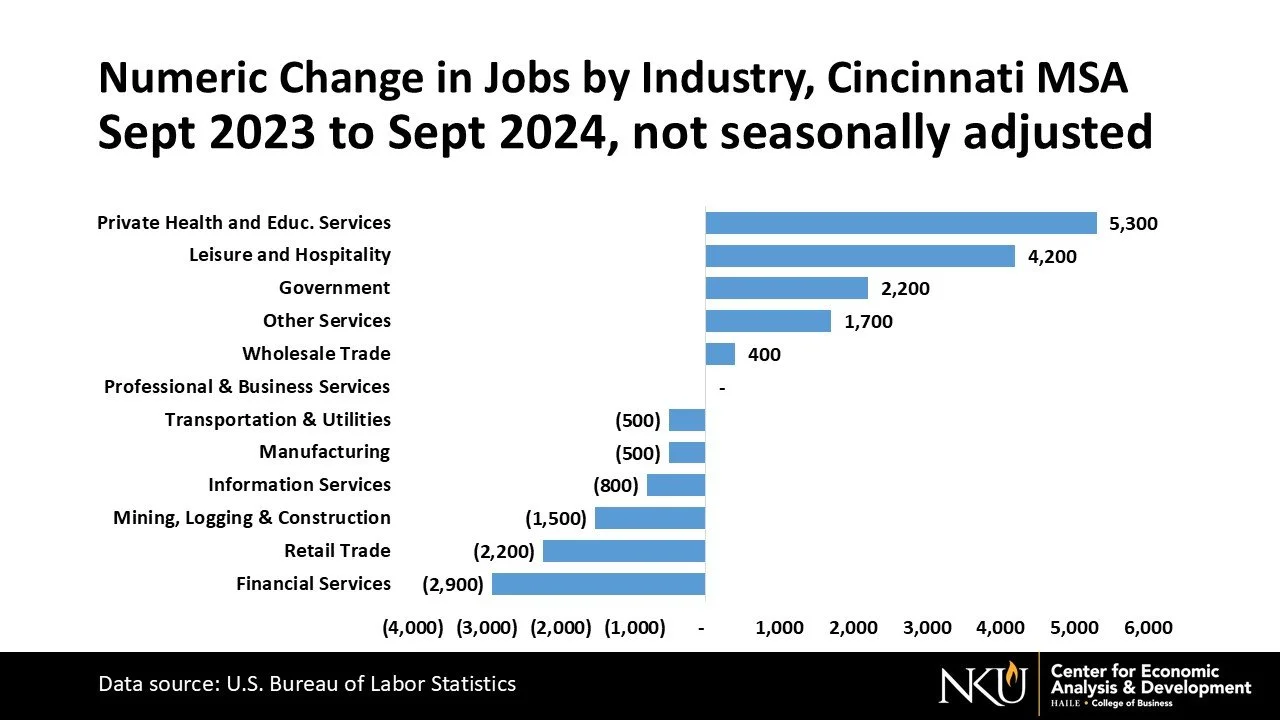
Whereas our market has typically mimicked the country in terms of job growth, Harrah noted that Greater Cincinnati has begun to lag the United States. Our employment growth is projected to slow to 0.25% in 2025, significantly lagging the national rate of 0.8%. But she stressed that job growth in Northern Kentucky has been the bright spot in the Greater Cincinnati economy with a substantial percentage of the new jobs occurring in Kentucky, particularly in and around the airport.
3. Unemployment is ticking upward, locally and nationally. Greater Cincinnati’s unemployment rate typically mirrors the nation, and that continues to be the case, as seen below. The unemployment rate has risen slightly over the past 12 months. Harrah said currently there is about one job opening for every available worker here and nationally.

However, this does not mean that employers can easily find the talent they need, largely because of the skills gap (see point 4 below). Furthermore, as individuals lose their jobs, many are opting not to re-enter the traditional workforce but are instead entering the so-called “gig economy.” Although not clearly defined, the gig economy includes jobs individuals do as freelance workers, such as Uber drivers, dog walkers, and food-delivery jobs. Roughly 15% of the labor market are gig workers – and that percentage is higher in Kentucky (16.3%). Gig workers are self-employed and are foregoing access to healthcare and retirement benefits through employer plans.
4. Our workforce does not currently possess the skill set needed for jobs in the future. During the Eggs and Issues meeting, both Harrah and her co-presenter John Augustine referenced the skills gap. Augustine mentioned a desire by President Trump’s incoming administration to “reshore” manufacturing jobs. That is, to increase the goods produced by American companies rather than purchasing them from foreign sources. However, currently, the American labor force does not have the training needed to perform these technology-based manufacturing jobs.
The skills gap affects virtually every industry and is increasing as the use of technology increases. Technology has replaced some jobs. More often, however, people work alongside technology in the workplace. The term “cobot” refers to this practice: humans and robots work together to accomplish tasks.

“Cobots” is the term attributed to robots and humans working together to perform job tasks as in the photo above.
What’s the bottom line? Since job growth is slower and unemployment is increasing, is the talent shortage behind us?
Absolutely not.
Even if our economy stagnates, we will not have enough people to fill our jobs by 2050. There are too many people retiring, and too few young people to fill their ranks. We must continue working to retain our current residents while simultaneously bringing in new workers. There are tangible things we can do now to prepare for the future: Providing training to address is skills gap is essential. Increasing our immigrant population is critical. Helping all potential workers enter the labor force is a “must-do.” Addressing concerns like the housing shortage is necessary. Fortunately, our region is already working to address these priorities.
If you are ready to get involved, reach out to NKY Works. We will connect you to the teams of local experts who are working together to tackle these challenges. NKY Works is also available to help address your specific workforce issues. We can connect you to resources and troubleshoot solutions with you. You can reach us at 859.657.WRKS (9757) or NKYWorks@NKADD.org.

The Digital Skills Gap Affects All Employers
Virtually all jobs require digital skills, but these skills are often lacking in our workforce.
NKY Works gathers local subject matter experts on a regular basis to discuss how we as a region can best connect employers with the talent they need in light of ever-evolving workforce dynamics. This month, our focus area on Employer Best Practices welcomed guest speaker Jeran Culina, a senior manager at the National Skills Coalition (NSC). She discussed the skills mismatch in today’s workforce. The “skills mismatch” is a discrepancy between the skills sought by employers and the skills possessed by individuals. The available jobs require a certain set of skills, but the available workforce does not have those skills. In some cases, the mismatch reflects a lack of training among potential workers. Sometimes, workers have the “wrong” training, meaning their skills no longer align with the high-need jobs in their area. Often this points to a need to “upskill” existing workers whose skills have not kept up with rapidly changing technology.
Rapidly changing technology has exacerbated the skills gap because most jobs now require some digital skills. In 2021, the NSC analyzed 43 million “help wanted” ads across the country. They found 92% of all job openings required digital skills. Nearly half of these openings described requirements that the NSC classified as definitely digital, such as the ability to use a specific software program. Another 45 percent included requirements they labeled as likely digital. Examples include customer account review, making travel arrangements, and clerical support. Only 8% described jobs that did not require any digital skills. Further, all industries required digital skills, even those typically thought to be rooted in hands-on skills, like construction, manufacturing and food service.
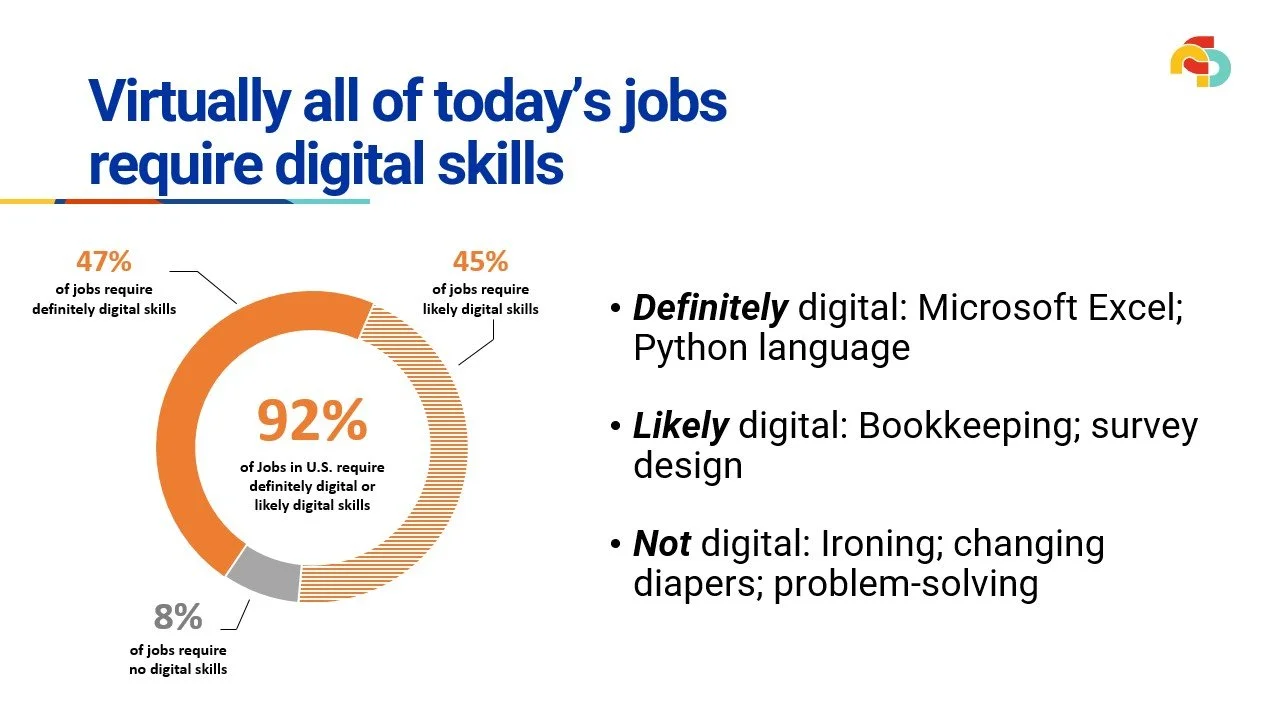
Above, slide showing percent of jobs requiring digital skills from the National Skills Coalition
The need for digital skills is true at all experience levels, including entry-level positions. The NSC study found that 95% of entry-level job postings required skills that were likely digital or definitely digital, and the expectations increase with experience. For example, essentially all jobs requiring 6 to 8 years of experience include digital duties. Likewise, jobs at all educational levels required workers to possess digital skills, as seen in the chart below. Note the strongest link to digital skills is for jobs requiring bachelor’s degrees.

The good news for workers is that jobs with digital responsibilities pay dramatically better. Per the NSC study, jobs that require even one definitely digital skill pay 23% better than jobs that do not require digital skills. That means that acquiring digital skills can help workers qualify for jobs paying a living wage.

Above, slide showing pay increase for workers with one definitely digital skill
You might think that all Americans possess at least one digital skill, but unfortunately, that is not true. Almost one-third of our workforce does not have the necessary digital skills. Thirteen percent have no digital skills at all, and 18 percent have limited digital skills. This is true even among our youngest workers, those “digital natives” who grew up with easy access to smartphones, tablets and computers. The NSC found young workers have “fragmented” digital skills and described this situation this way:
That is, they are comfortable with some digital tasks, such as sending a text message or making a TikTok video, but not comfortable with others, such as creating a spreadsheet. For this reason, it’s especially important that workforce and education programs provide opportunities for people to build from the skills they have to the skills they need (Closing the Digital Skill Divide: The Payoff for Workers, Business and the Economy, p 10).
The good news for companies is that digital skills can be taught. Companies can embed training for their specific digital skills in their onboarding process with new workers. They can provide ongoing training to upskill their existing workforce. There are several funding options and training programs that may be available to help. For example, Kentucky companies may qualify for funding to support upskilling through the KCTCS TRAINS program. (Learn more about TRAINS program at Gateway Community and Technical College here.) The payoff for this investment will be employee retention and increased workplace productivity. Retaining even one productive employee saves companies from $25,000 to $78,000 in turnover costs, per the NSC. You can access the full NSC report for more details here.
NKY Works can help your company identify your digital-skills gaps and connect you to resources to address your specific needs. We can also discuss potential funding opportunities and available training options for you and your workers. To learn more, contact us at 859.657.WRKS (9757) or NKYWorks@NKADD.org.
The NKY Works Employer Best Practices Focus Area meets monthly, typically using a virtual platform, to discuss a wide range of topics affecting workforce development in Greater Cincinnati. To get involved, contact Vicki Berling.

Embracing ‘Gen z’ in the workplace
How do “Gen Z’ workers in Greater Cincinnati see their jobs and what do they want from their employers? Learn more in this blog.
They’re here.
In fact, they have been here in the workforce for nearly a decade. We’re talking about Generation Z – ‘Gen Z’ – individuals born between 1997 and 2012. The oldest will be 28 soon, and the youngest is now in middle school. They are a massive group of individuals comprising 20.7% of the US population. They are also the most diverse generation in US history in terms of race and ethnicity. The Census Bureau reports 49% of them identify themselves as a race or ethnicity other than non-Hispanic white. What they think about the world and the workplace is notably different than their predecessors.
The Workforce Innovation Center of the Cincinnati Regional Chamber of Commerce recently completed a comprehensive study of Gen Z in our local workforce. They are publishing the results in two parts. The first focused on Gen Z individuals on a “university track,” meaning they have completed or are completing a four-year college degree.

The chamber just released their findings for this group, and you can request the full study here. Part 2, to be released in January, will report on those individuals who have entered the workforce without bachelor's degrees.
Part 1 confirms several themes NKY Works has explored. Only 41.6% of Gen Z’ers intend to stay in Greater Cincinnati after they graduate. Many who leave here stay in and around the Midwest. They are also attracted by large metropolitan areas, such as Chicago, New York City, Boston, Denver and Los Angeles. They cite better career and educational opportunities in these locations as primary reasons they leave Greater Cincinnati.
When searching for a job, study participants listed the following as the most important job features:
1. Salary
2. Flexible schedule
3. Culture and values
4. Location
5. Belonging
They listed the least important job features as:
1. Company size
2. Pay
3. Work from home/remote work
4. Political stance
5. Mental health benefits
While it may seem like “salary” as a top feature and “pay” as a bottom feature are conflicting, the study amplified the finding by adding: “If they perceive that a role provides reasonable pay and is clear about growth opportunities in the future, they are willing to take that role.” In other words, well-defined career pathways are important in their job-search process.
Throughout, the study found that Gen Z workers want to be respected and valued by their employers. They care about work, but they care about the world at large, too. They want to have full lives with hobbies, passion projects and deep relationships. They wish employers knew:
They are trainable and comfortable with change.
They want to make an impact on the workplace and the world at large.
They expect clear communication and transparency in the workplace.
They seek open, honest feedback.
They want to be treated as equals even though they know they are young.
The study concluded by offering the following action items that employers can do to attract and retain Gen Z workers.
RECRUIT FAIRLY AND BROADLY • Create accurate job descriptions, without prohibitive requirements • List compensation publicly • Explain career mobility options • Provide systematic support immediately upon hire
ENHANCE LEADERSHIP EFFECTIVENESS & COLLABORATION • Provide direct feedback about performance and communicate with employees regularly • Create a formal mentorship program with authentic mentors who are values-aligned • Provide opportunities for networking and community involvement • Provide training to managers and supervisors
INSPIRE A SENSE OF MEANING & BELONGING • Conduct employee experience/well-being surveys and use data to inform policies and practices • Create a clear connection to the company mission • Focus on creating an inclusive environment • Create statements and policies on diversity, equity, inclusion, and belonging within your organization.
If your organization is struggling to find and retain talent, NKY Works can connect you with resources to address your challenges. Contact us at NKYWorks@NKADD.org or 859.657.WRKS (9757).

November NKY Works Newsletter is here…
Follow this link to read our November newsletter:
https://mailchi.mp/f7d4e63ffbcc/workforce-news-from-nky-works

NKY Offers Exciting Careers in Advanced Manufacturing
Northern Kentucky offers exciting careers in advanced manufacturing.
October is National Manufacturing Month, and it’s a great opportunity to highlight the importance of Advanced Manufacturing to our state and local economy.
Did you know:
Manufacturing is responsible for $41.8 billion to Kentucky’s economy, which is 16.1% of the state’s Gross Domestic Product (GDP)?
More than 250,000 people work at Kentucky’s 4,000 manufacturers?
About 38,000 people in Kentucky’s Fourth Congressional District work at 593 manufacturing companies?
The average annual wage of manufacturing employees in Kentucky is $84,433, compared to $67,629 average for non-farm workers?
(Source: National association of Manufacturers, Kentuchttps://nam.org/manufacturing-in-the-united-states/regions/kentucky/ky - NAM)
With the strength of this segment of our economy, it’s concerning that interest in advanced manufacturing careers lags behind other industries amongst high school students about to enter the job market. Our recent YouScience regional report showed that 14% of 2025 high school graduates have an aptitude for these careers but only 7% have an interest (Career Readiness — NKY Works). Perhaps students still envision the “dirty,” labor-intensive jobs of the past, but modern manufacturing jobs are heavily rooted in technology and rely on STEM-related skills! One way Northern Kentucky is focused on increasing student awareness of and interest in manufacturing careers is through the coaching, shadowing and summer camps offered through the NaviGo program.

Photo: Woman working in technology-based manufacturing environment
Locally, our manufacturing jobs are primarily in the automotive, aviation & aerospace, food & flavoring, materials & packaging, and medical device manufacturing sectors. Learn more about advanced manufacturing in Northern Kentucky at this link from the BE NKY Growth Partnership: Advanced Manufacturing – BE NKY
Post-secondary students in Northern Kentucky have an outstanding opportunity to train for manufacturing jobs while working in the field through the NKY FAME Program. The Kentucky Federation for Advanced Manufacturing Education (KY FAME) is a partnership of regional manufacturers whose purpose is to implement career pathway, apprenticeship-style educational programs that will create a pipeline of highly skilled workers. Locally, FAME partners with Gateway Community and Technical College. Students attend classes full-time at Gateway two days a week and work at their sponsoring manufacturer three days per week, providing a balanced and immersive educational experience.
“The NKY FAME program at Gateway Community and Technical College is a transformative opportunity for students to gain hands-on experience and advanced technical skills while earning their degree,” Gateway Director of Career and Experiential Learning Caitlin Fugate said. “This program not only prepares students for high-demand careers in manufacturing but also fosters a strong work ethic and professional growth through its unique blend of classroom learning and real-world application.”
The admission criteria and application process are described at this site. (Be sure to listen to the two student testimonials at that site to hear how FAME has impacted their lives.) Although there is no specific application deadline, interested students are encouraged to apply early as program interviews begin in February. Gateway will hold a FAME open house for parents and students in February where they can tour the program and talk with the NKY FAME employers.